What is Light Activated Disinfection (LAD)?
Light Activated Disinfection (LAD) will probably be one of the most promising new technologies in dentistry in the next decade. LAD is a variation of the broader technology PDT Photo Dynamic Therapy, which has been used in medicine the last 20 years or more. LAD has also been known for several years, it is however only due to improved technology that it is now possible to apply the concept successfully in clinical practice. Improved hardware makes it possible to treat patients in seconds or a few minutes.
FotoSan® LAD Treatment
The created reactive oxygen specimen (ROS) exist only for a very short time ( few nano seconds) and are only transported over very short distance (few microns). This is also a reason why human cells are not affected.
- A photo sensitizer is used to bond to the surface of the microorganisms.
- The photo sensitizer absorbs light with a specific wavelengths, thus taking up energy.
- This energy is released and reacts with O2, splitting that into either O- or O+ , in common known as ROS. (Reactive Oxygen Specimen).
- ROS is highly reactive and destroys microbial cell membranes and inner structures instantly. The LAD principle is effective not only against bacteria but also other microorganisms such as virus, fungi and protozoa. The photo sensitizer used has much lower affinity for mammal cell membranes, which is why mammal cell membranes are not affected by the reaction, and in practice why we see no side-effects.
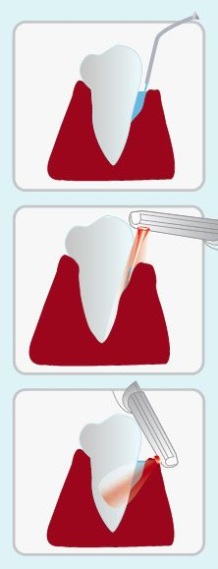
FotoSan LAD is a highly specialized equipment used as an adjunct to the treatment of periodontal and endodontic treatment. The principle of the FotoSan LAD treatment is as follows:
The 6 advantages of FotoSan LAD treatment:
- Immediate effect.
- Efficient against all microorganisms.
- Dose depending effect.
- No immunization effect.
- Can be repeated unlimitedly.
- No known side-effects.
Read about a case report with FotoSan LAD.